

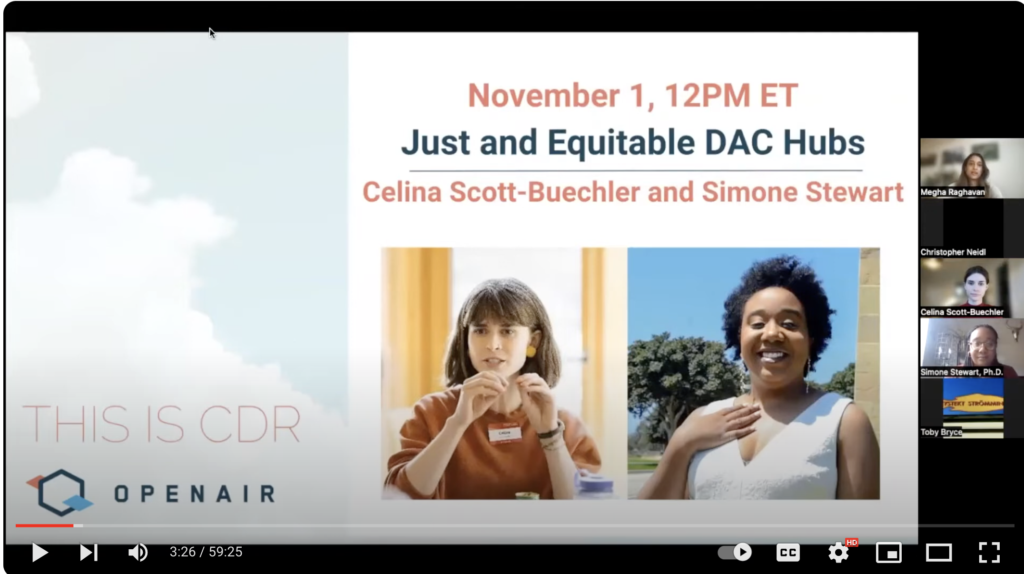
“Extending existing frameworks that are inherently limiting, to include people they were not originally meant to include is incredibly difficult, but the end goal is what motivates me and seems so rewarding.” ~ Dr. Simone H. Stewart, Senior Industrial Policy Specialist in Climate & Energy Policy at the National Wildlife Federation (NWF), Global CO2 Initiative (GCI) Advisory Board Member.
Simone, the newest member of the GCI Advisory Board, works at the intersection of carbon management (including carbon capture and carbon removal), energy/environmental justice, and policy. She holds a Ph.D. (Mechanical Engineering) from the University of California Santa Barbara and two B.A.’s (Physics and Spanish Language & Literature) from William Jewell College. Two of her many awards include being named a National Science Foundation Graduate Research Fellow and Dixon-Levy Graduate Student Association Service awardee which she received for her work on campus supporting BIPOC graduates in STEM fields. For two years Simone also worked as a Graduate Assistant at the UCSB Blum Center on Poverty, Inequality, and Democracy.
What is a very simple explanation of what you do?.
I help create policies that focus on cleaning up our environment and keeping communities and their rights safe. As far as carbon management, I do work on industry—the part of our society that makes goods we need to make buildings, highways, homes, and other structures (like steel, cement, and glass). Those industries produce a lot of pollution which hurts our planet.

So I help the government and people who run projects think about how to use technology to create solutions to these problems. I also work with communities to help them learn about the environment, the danger our planet is facing, and share their thoughts and fears with the government.
You work at the intersection of carbon capture and climate justice. What is your hope for this area? What advice do you have for those who may be more familiar with the former topic and not so much the latter?
My hope is that as environmental and climate justice become more mainstream talking points that they not only continue to be integrated and enshrined into political structures, but that everyone will continue to educate themselves about why environmental and climate justice is necessary.
I also hope they will continue to seek out ways to challenge the systems that perpetuate injustice. In the future I hope carbon management becomes more interdisciplinary, that engineers and social scientists and community advocates are not siloed, that beyond expertise, people should have a foundational knowledge about the way technology and society interact.
For those knowledgeable about carbon capture but not environmental or climate justice, I would suggest that they
- seek out resources to define terms, discuss historic movements, familiarize themselves with historic policies and how they interact with modern society;
- confront the way that they as individuals, their industries, sectors, or organizations perpetuate and benefit from injustice; and
- engage with communities and listen with open minds.